In October 2025, Bloomberg revealed that OpenAI had entered massive, intertwined deals with chipmakers Nvidia and AMD. The arrangements are so circular they could fuel the next trillion-dollar wave in artificial intelligence.
To some, it is a visionary coordination between hardware and AI. To others, it is a self-reinforcing financial loop that looks eerily like the last dot com boom and bust of the early noughties.
If history is any guide, moments like this do not just build technologies. They write the economic playbooks that future generations will study. The question is whether this one will be remembered as the foundation of the AI century, or as the script of its first great bubble.
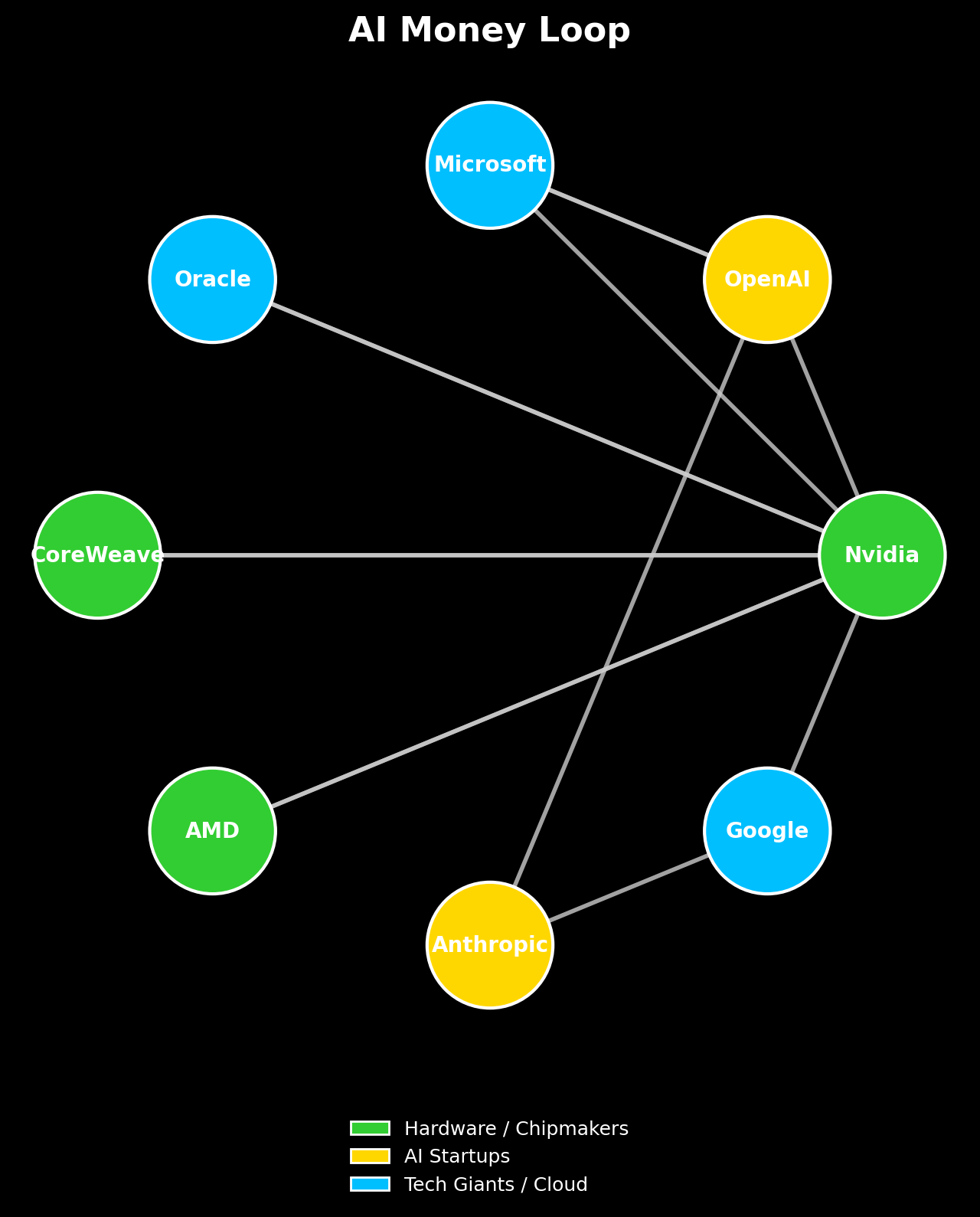
The circular flow of AI investments across hardware makers, AI startups, and tech giants
What Is Actually Happening
Imagine three companies working in a loop.
OpenAI creates artificial intelligence models.
Nvidia produces the chips that is required to power them.
AMD provides an alternative supply of those chips.
Normally, OpenAI would simply buy chips from these suppliers as and when. But these new deals now go far beyond that.
Nvidia has reportedly invested tens of billions into OpenAI to help fund new data centres that will house the servers that are required to drive the AI model processing. In return, OpenAI has agreed to use Nvidia's chips in those same facilities. With AMD, OpenAI has committed to buying huge volumes of chips in future and even has the right to purchase a stake in AMD itself.
The lines between supplier, investor and customer have now become extremely blurred. Now we have a process whereby each company helps to sustain the other's valuation via contracted purchases. It is a circular system where investment and spending reinforce each other.
Why It Works, For Now
At first glance, this looks brilliant and let's be clear it is not illegal. OpenAI needs capital to scale fast. Nvidia and AMD want guaranteed customers for their chips. By combining funding with long term purchasing commitments, everyone wins.
It is an exceptionally smart way to guarantee demand. But it also concentrates enormous risk. If one company falters, there will be a complete knock-on effect and the others will immediately feel the shock.
How This Could Become a Bubble
To understand the danger, let's imagine how the story could unfold.
Stage 1: Exuberant optimism
Investors believe AI will transform everything. As a consequence, valuations will then surge based on their potential rather than the actual revenue and profit realised.
Stage 2: Rapid expansion
Based on these increased valuations this builds more confidence to lenders and borrowers alike. OpenAI and its peers then begin to take on additional debt to build and expand their infrastructure to drive operations. The resultant growth is then measured by the size of the machine and not by the actual economic performance and stability.
Stage 3: Warning signs
Energy costs begin to rise, chip shortages start to emerge, regulations then tighten, and economic investment returns take longer to appear. Confidence begins to weaken.
Stage 4: Contagion
When one link in the chain breaks, the rest are ultimately pulled down. Because the companies are financially entangled, a slowdown or liquidity shock at one can quickly reverberate and ripple through the entire AI supply chain.
This is the anatomy of a bubble. Optimism feeds on itself, until fear does the same.
Echoes of the Dot Com Era
The late 1990s followed a very similar pattern. Internet companies invested in one another to inflate valuations. The crash that followed wiped out trillions in paper wealth. Yet conversely, it also built the digital backbone we heavily rely on today.
AI may follow that same trajectory, even if a correction does arrive, the infrastructure built during this boom; data centres, chips, computing power will remain and the foundation upon which the next wave of innovation will be built. Evidence and history dictate that this is a cyclical process of undulating peaks and troughs and that it always has been.
The Making of an Economic Bible
Every technological revolution leaves behind a playbook of how things spin out. The AI era will be no different. Out of this boom a new set of principles are already beginning to evolve and emerge.
1. Scale before profit
Building infrastructure comes first. Monetisation comes later.
2. Circular investment as a norm
Suppliers, investors and customers often share the same balance sheet. It becomes a symbiotic relationship that benefits all.
3. Compute as the new capital
Owning computing processing power is as strategic as owning energy or land.
4. Valuations based on capability, not revenue
This has been around for a while, but it has somewhat evolved: efficiency and technical progress matter more than short term profit.
5. Governance as a necessity
Transparency and regulatory discipline will become essential to prevent systemic fragility.
These will form the foundation of what might become the economic bible of the AI age principles every founder, investor and policymaker will eventually study and follow.
Why Does This Matter?
For investors, policymakers and founders, a core understanding of these patterns earlier on in the game are mission critical. The signs of excess are already clearly visible, but so are the opportunities.
Those who grasp the mechanics of circular finance, energy dependency, and capital concentration will have the upper hand when the market shifts. This moment as we speak is rewriting the rulebook of a new economy. Whether it reads as a story of progress or a warning of overreaching will depend highly on how the next chapter pans out.
Sources
- OpenAI's Nvidia, AMD deals boost $1 trillion AI boom with circular deals - Bloomberg
- AMD signs AI chip-supply deal with OpenAI, shares surge over 34% - Reuters
- Nvidia to invest up to $100bn in OpenAI
- OpenAI signs multibillion-dollar chip deal with AMD - The Guardian
- The billion-dollar infrastructure deals powering the AI boom - TechCrunch